The basics of Recordia Transcription

The basics of Recordia Transcription

Today, call recordings and transcripts are important part of an effective customer service experience. The fact that Call Center agents can use text transcriptions of their calls will help them not only to know the quality of the service they provide, but also the needs that customers demand in order to adapt their speech or products to these needs.

It is because of this need to improve the customer experience and the quality of the service that Artificial Intelligence based solutions arise to facilitate this task. This is how Recordia Transcription technology arises.

<<< Find out all you need to know about Recordia Transcription >>>

What is Recordia Transcription?

Call transcription is the process of converting conversations that take place through a phone call into written words (also known as Speech to Text Transcription). Call Transcription software converts this process into an automatic process and can occur in real time or after a call has been recorded. Call transcriptions provide sales reps with reviewable records of every conversation they have with customers.

Recordia Transcription works with great accuracy and understands interruptions or overlapping voices, distinguishing them and delivering the complete conversation in text, differentiating all interlocutors, which allows later analyzing calls individually or globally through Speech and Sentiment Analytics, or using them as evidence.

How does Call Transcription work?

Transcription software works by listening to audio and delivering an editable textual transcript to a given device through speech recognition. The conversion from speech to text is powered by a complex machine learning model in order to be done in several steps.

Recordia records the interactions and sends them to our transcription software. Once received, the software reads the electronic signal of the words, taking the sounds, measuring their waveforms and filtering them. Finally, the mathematical model behind the technology goes to the dictionary with which it has been previously trained and translates the sound into the most probable word according to the context.

Recordia Transcription is able to understand interruptions and overlapping voices, distinguishing them. In addition, with Recordia you have the possibility of adapting the dictionary of words that the technology uses according to the context in which your business is, making a more reliable speech-to-text transcription adapted to your needs.

What are the benefits of Recordia Transcription?

Automated notetaking

No more need for your salespeople to be distracted by taking notes, let your team put all their attention on listening to your customers, making valuable contributions and overcoming possible objections. Recordia Transcription detects overlapping voices and interruptions, so you can get quality notes without worrying about taking them yourself.

Increase sales performance

Enrich your CRM and easily identify in your transcripts your strengths and weaknesses, pain points and major objections or concerns about your product. Define your objectives, refine or readjust your value proposition and take advantage of hidden opportunities to make more sales and attract more qualified leads.

Enhanced employee and onboardings training

By transcribing and analyzing each call you not only find what is and isn’t working in every agent’s sales pitch, but also you can make 1-to-1 personalized training and provide your team with specific feedback to make them close more deals.

Also, don’t just focus on your already hired agents, make your onboarding process faster and smoother, show them real calls to train them and give them tools to overcome every situation possible, empower your Call Centers agents with real scripts to build better sales and call center teams.

Improve process quality

When conversations are transcribed into written text, you can efficiently search and reference specific highlights, keywords, and phrases. Search and scan call transcripts to identify inefficiencies, waste and areas of improvement, and collaborate with different departments by sharing transcripts within improvement proposals.

Do you want to know more about Recordia Transcription? You can find more information here.

The basics of Recordia Biometric Identification

The basics of Recordia Biometric Identification

All those companies that collect and work with customer data must be rigorous in terms of protecting and authenticating this data properly. With the constant changes and technological developments and the creation of new solutions coming to the market every day, this may seem easy, but that is exactly why the task becomes more complicated. Cyber-attacks and fraud are a daily occurrence for many companies and customer data is left unprotected and within the reach of anyone.

To facilitate this task, protect data and prevent fraud, new solutions such as Recordia Biometric Identification have emerged.

<<< Discover the new Recordia solution: Voice Biometric Identification >>>

What is Recordia Biometric Identification?

Biometric Identification is simply the process of verifying a person’s identity using their unique characteristics and then allowing them to access a service, application or device securely.

To understand it better, biometrics is the general name used to refer to any biological measure, or physical characteristic, that can be used to identify people, such as facial pattern, fingerprint, voiceprint or iris pattern, among others. In this way, Biometric Identification verifies the identity of people according to the chosen biometric characteristic, in the case of Recordia Biometric Identification through the voiceprint of each customer.

But do not confuse the famous voice recognition with the voice identification that we discuss in this post. Although both are guided by one of the biometric characteristics we are talking about, the voice, voice identification consists of verifying the identity of the speaker, while voice recognition tries to understand the words that are pronounced. In other words, the first one identifies the person and the second one recognizes only what the person says.

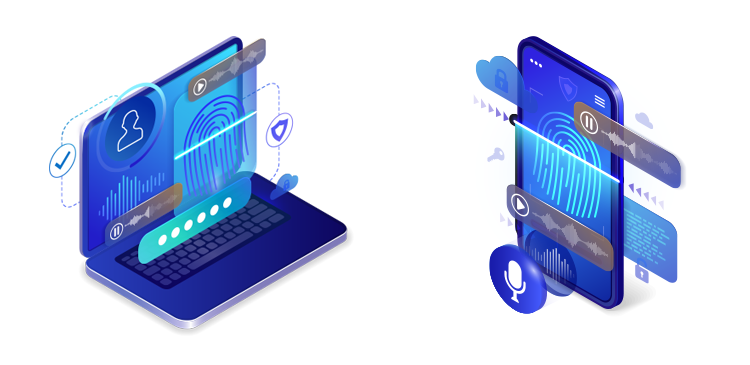
Thanks to Recordia Biometric Identification technology, you will be able to accurately identify your customers in a matter of seconds by recognizing each customer’s specific voiceprint.

How does Biometric Voice Identification work?

Biometric Voice Identification technology captures and measures the physical qualities of a person’s voice when speaking, as well as the unique biological parameters that combine to produce that voice. These vocal qualities include the intensity, cadence, pitch, tone and dynamics of that voice.

With the first call, Recordia records the voiceprint in its database. This voiceprint is created by capturing the dominant frequencies and tones in spoken words and reducing them to a digital format. This voiceprint is unique to each person.

Once the voiceprint is registered in the database, in subsequent calls the system will compare the voice with the registered voiceprint, avoiding the need for identification each time the customer calls and increasing speed and security.

What are the benefits of Recordia Biometric Identification?

Increasing customer authentication security

Voice biometric solutions are one of the most secure ways for customers to identify themselves. They do not have to share their personal data or passwords over the phone or answer security questions that are usually forgotten. In addition, when a customer calls a Call Center that uses this type of voice identification, they can be assured that the data collected is stored securely and is not prone to any type of fraud or crime.  

Increasing customer satisfaction and agent efficiency

In addition to authentication being more secure and fraud-free, customer satisfaction is increased due to faster identification. In Call Centers in sectors such as banking or healthcare where customer identification usually takes between 2 and 5 minutes, it is especially beneficial to use technologies such as Recordia Biometric Identification with which you will be able to identify customers in a matter of seconds. This will not only increase customer satisfaction but will also increase the efficiency of call center agents, reducing attention and waiting time and the stress levels typical of call centers.  

Assisting to detect telephone fraud

The best voice biometrics technology not only works as a method to authenticate customers and prove their identity but can also help agents detect phone fraud. With Recordia Biometric Identification, an identity check is performed throughout the call and automatically warns you on screen in case the ID does not match.

Helping to comply with data protection regulations

Recordia helps to comply with data protection regulations by collecting and storing individual consents for the processing of personal data and protects companies from fraud by accurately identifying customers. With Recordia Biometric Identification you can keep your customers’ consent for the processing of personal data updated at each call and automatically detect on screen in case it is missing.

Do you want to know more about Recordia Biometric Identification? You can find more information here.

The basics of Sentiment Analysis

The basics of Sentiment Analysis

Analyzing and understanding the emotions of audiences is fundamental for companies. Today, customers have been expressing their thoughts and feelings more openly than ever before. By automatically analyzing customer feedback with AI technologies, companies can listen carefully to their customers and tailor products and services to meet their needs.

One of these Artificial Intelligence technologies is Recordia Sentiment Analysis, Recordia sentiment analysis solution.

<<< Discover all about Recordia Sentiment Analysis >>>

What is Recordia Sentiment Analysis?

Sentiment Analysis is one of the fields of natural language processing dedicated to exploring subjective opinions or feelings collected from various sources on a particular topic.

In narrower business terms, it can be summarized as the application of a set of tools and algorithms to identify and extract opinions and feelings to use for the benefit of the business operation. These algorithms delve into the content and find that which indicates the feeling towards the product in general or a specific element.

Created through neural networks, Recordia Sentiment Analysis technology allows to identify the feelings of the different interventions of a call and its level of satisfaction. It is an opportunity to explore the mindset of audience members and study the perception of the product or service from the user’s point of view. This makes Sentiment Analysis a great tool for an in-depth products or services analysis, market research, reputation management or customer service analysis, among others.

How does Sentiment Analysis work?

Sentiment Analysis is a process that uses Artificial Intelligence (AI) and Machine Learning and aims to find points of view, keywords and feelings, highlighting the information of interest in the process and the emotional insights of your customers, whether good, neutral or bad.

Sentiment can be defined as the result of “an opinion or judgment formed about something, not necessarily based on facts or knowledge”. In fact, an opinion is understood as a subjective evaluation of something based on personal empirical experience, that is, it is based on a feeling about a particular topic. It is therefore important to consider these customers feelings because they are directly based on personal experience with your business.

Recordia Sentiment Analysis technology allows, through large-scale data processing of millions of conversations, to discover which keywords and speech patterns cause favorable results in the customer, obtain statistics and analysis of situations in real time and use the result to make quick decisions, discover causes of problems or common trends and detect and identify voice patterns of call agents.

What are the benefits of Recordia Sentiment Analysis?

Boosting CX and customer service

Since Sentiment Analysis allows you to monitor customer emotions in real time, it is a perfect tool to monitor the quality of your customer service and customer experience (CX). Recordia Sentiment Analysis will allow you to know the weak points of your customer service and will help you to quickly detect problems that arise with your customers. In addition, it will allow you to detect the feelings of your customers when they communicate with your agents, which will help you discover which agents manage to provide an efficient service and which ones need to improve their performance to increase customer satisfaction. Recordia Sentiment Analysis is key to determine what satisfies customers and thus better train new customer service agents.

Improve and measure marketing campaigns performance

Recordia Sentiment Analysis provides marketing insights and allows you to measure the performance of your promotional campaigns and events. Using it, you can find out whether your marketing activities generated positive or negative reactions and subsequently verify your customers’ feedback. This helps you rethink your marketing strategies and, if necessary, better tailor your messages in the future to suit customers’ tastes and needs. Detecting negative, positive or neutral feelings about your marketing campaigns will help you measure their success.

Analyze and adapt your products

Customer opinions about products are influenced by many different factors and even change on the fly, such as feature enhancements, price increases or marketing campaigns. All these factors arouse all kinds of emotions in customers. Product managers need to constantly monitor how customers respond to these and the changes they experience. Recordia Sentiment Analysis makes it possible to transform a large amount of qualitative product data into quantitative insights and thus gain more information about how customers perceive your solutions and what to do and how to improve them.

Analyze fluctuations and make market predictions

Customer reviews can affect the direction the market takes. That is why, in markets such as securities, the data shows that there is a strong correlation between stock prices and the feelings expressed by customers, due to the influence of these feelings on the reputation of brands. If a brand has a bad reputation due to the numerous negative opinions held by its customers, the stock price will be affected. Recordia Sentiment Analysis helps you to know the feelings of your customers about your brand and thus determine the levels of satisfaction regarding different factors such as products, services or attention received, and anticipate the possible fluctuations that may occur in the market in which your business operates.

Do you want to know more about Recordia Sentiment Analysis? You can find more information here.

The basics of Recordia Speech Analytics

The basics of Recordia Speech Analytics

If you are evaluating to incorporate Speech Analytics technology into your company, although it seems obvious, the first thing you need to understand is what Speech Analytics is and how it works. Speech Analytics has been the Call Center tool with the biggest and fastest growth in the last years and your company could benefit from it.

<<< Learn more about Recordia Speech Analytics solution >>>

What is Recordia Speech Analytics?

To easily understand what Recordia Speech Analytics is, we can define it as a technological tool, powered by Artificial Intelligence, that automates the process of listening and analyzing conversations with customers. Known as an enterprise software solution, Recordia Speech Analytics extracts, analyzes and processes information from customer interactions that, without this technology, would be manually impossible to perform, losing all the potential that all this unstructured information has within. Although Speech Analytics was originally designed to identify and analyze only the words or phrases spoken, the most modern Speech Analytics solutions such as Recordia’s are also capable of analyzing the emotional character of the conversation (Sentiment Analysis), the silence and overlaps that occur in it.  

How does it work?

The operation of Recordia Speech Analytics is divided into several stages in order to process conversations and finally obtain information of strategic value for companies.

The first step is to have a call and interaction recording solution, such as Recordia Call Recording, in order to capture conversations and save them for future processing. This process takes the unstructured data found in those conversations and turns it into structured data that can be searched and analyzed, including associated metadata such as the people on the call or the day and time when the interaction occurred. Once the audios of the conversations and their organized metadata (structured data) have been obtained, the next step is to process them through speech recognition by converting the sound of the words into text.

Finally, Recordia Speech Analytics technology automatically analyzes the interactions through language patterns, categorizing or tagging the interactions that contain certain important characteristics for the business. Recordia surfaces hidden information, beyond surveys and reviews, to help you understand what is happening in your business based on the keywords and aspects you seek to uncover about your business operations.

Once all this hidden and interesting information is obtained from the interactions, you can perform specific searches for the analysis of categories and criteria, visualize data or configure the automatic analysis of topics of interest.

What are the benefits of Recordia Speech Analytics?

Improve service and product quality

Companies today have many more options to address customer issues in a timely and, in some cases, proactive manner. Recordia Speech Analytics recognizes not only that a customer is complaining, but specifically what they are complaining about. For large companies with multiple product or service offerings, this is critical because it can enable personalized offerings that are carefully tailored to customers’ situations. When that happens, customers feel they are heard and understood, and that is one of the best ways to increase brand loyalty.  

Coach and train employees

As we say, today’s companies have many more options that allow them to proactively address complaints. Addressing them and detecting common queries will be really useful for the quality training of, for example, call center agents to equip them with resources that will help them deal better with customers and reduce their team’s stress levels when facing with uncomfortable situations or possible problems arising in customer services processes. Thanks to the detection of key words or insights and bad practices in your customer service processes with Recordia Speech Analytics, you will provide your employees with the training they need to ensure high quality standards.

Boosting customer acquisition and retention

Attracting and retaining customers is vital to grow your business but losing them can happen quickly and it is therefore imperative that companies use Speech Analytics technologies to detect when this is likely to happen. For example, some insurance companies are using Speech Analytics to detect when customer interest is waning during sales calls. The goal is to enable salespeople from the insurance industry to quickly detect any warning signs and respond appropriately, increasing sales rates and improving customer service.

Improve marketing and sales campaigns

Thanks to Recordia Speech Analytics, your company will be able to discover what attracts your customers and what they miss in order to create campaigns to capture qualified leads and prospects. It is essential for companies to know their customers’ tastes and needs in order to adapt marketing campaigns to what really matters. On the other hand, Recordia Speech Analytics helps, thanks to the hidden information obtained from the indexing of 100% of the interactions, to detect the sales tactics that work best to close deals or cross-sell, and how to better focus your value proposition.

Want to learn more about Recordia Speech Analytics? You can find more information here.

The basics of Recordia Call Recording

The basics of Recordia Call Recording

Call recording is essential in some companies to comply with international data protection regulations and to achieve full ethical and regulatory compliance. The purpose of many companies is to store consents and call records of great legal and ethical importance in a secure and scalable environment for a certain period. Technological solutions such as Recordia allow you to perform these call recordings in a safe and responsible way, complying with international data protection regulations. However, Recordia Call Recording goes beyond that. 

<<< Discover Recordia Call Recording and ensures the regulatory compliance >>>

What is Recordia Call Recording?

Recordia is a high-tech cloud solution that allows you to record conversations in a digital audio file format, allowing you to store, playback, share and exploit those call recordings. 

Recordia not only records phone conversations, but also captures all omnichannel interactions across the company, whether they are calls, SMS, emails, faxes, video calls via MS Teams or 1-to-1 meetings. 

With Recordia, call recording is simple, by deploying it on your own PBX infrastructure, such as Oracle, Cisco, Alcatel, Avaya, Asterisk, BroadSoft or Unify, easily and quickly or through its RTS. The Recordia Telephony System (RTS) is Recordia cloud PBX system, and thanks to it that you can make and receive calls on any mobile device, IP phone or softphone client, allowing you to consult all conversations made through cell phones in a safe environment and without complex or sophisticated integrations.

What are the benefits of Recordia Call Recording?

Quality Assurance

Thanks to call recording, a Quality Manager can listen to interactions between their employees and customers in order to identify key areas where employees need improvement. This will help create plans for agents that include communication or product training to improve their customer service skills. On the other hand, call recording is beneficial in detecting areas of processes that are not working or have inefficiencies, as well as possible product improvements to better suit the needs of customers.

Facilitate and centralize day-to-day work

Recordia Call Recording software captures, encrypts and archives all calls and other interactions such as emails, SMS, faxes, video conferences, face-to-face, among others. All interactions with a customer can be accessed to accurately analyze details about an order or contact, for example, or to comply with personal data protection regulations such as GDPR, all from a single platform.

Customer satisfaction

The way a company’s employees interact with customers is very important. Customer service agents must communicate clearly, maintain a structure to the conversation and, above all, provide answers to the customer’s possible doubts and queries. Recordia Call Recording helps companies to review customer service processes and to aggregate key information such as comments, concerns and complaints from their customers within millions of calls, emails, chats and other interactions. Call recording with Recordia will allow you to discover what works and what makes your customers complain and leave, helping you make data-driven decisions to innovate and rebuild the entire Customer Journey. 

Customized training and coaching

The data and information collected and obtained through recorded calls can be used to provide training to employees. This is especially useful for calls centers where the importance of providing quality customer service is crucial to maintain high customer satisfaction rates. As we say, Recordia Call Recording is essential for call centers agents, who need personalized training and coaching, empowering them with real scripts and quality content to effectively address customer demands and inquiries. 

In addition, these Recordia Call Recording are useful to streamline on-boarding processes, reducing the learning curve of new employees through real calls to identify best practices and know how to solve problems that may arise in their interactions, achieving a more efficient training of new employees, as well as an improvement in the retention rate of your team of agents or sales representatives. 

International data protection and financial transparency regulations require all companies to comply in their business practices. Banks, insurance companies and other financial companies, among others, are constantly monitored and regulated by government and private entities. Recordia Call Recording helps to maintain compliance with all these regulatory groups and to avoid being prosecuted or penalized.

Recordia helps each of the specific verticals to store the legally and ethically important consent recordings and to access them with the possibility of being provided later as evidence, complying with international data protection regulations and ensuring an ethical and responsible use of them.

If you want more information about Recordia Call Recording, you can find it here. 

See you soon! 

Sentiment Analysis: What is it and what is it for?

Sentiment Analysis: What is it and what is it for?

What is Sentiment Analysis?

Sentiment Analysis is one of the fields of natural language processing, dedicated to exploring subjective opinions or feelings collected from various sources on a particular topic.

<<< Get to know how to analyze sentiments with Recordia >>>

In stricter business terms, it can be summarized as:

Sentiment Analysis is the application of a set of tools to identify and extract opinions and feelings to use them for the benefit of the commercial operation.

Such algorithms delve into the content and find what the sentiment indicates towards the product in general or its specific element.

Sentiment Analysis is an opportunity to explore the mindset of audience members and study the perception of the product from the user’s point of view. This makes Sentiment Analysis a great tool for:

  • Deep product analysis.
  • Market research.
  • Reputation management.
  • Customer service.
  • and many others.

How does Sentiment Analysis work?

Sentiment Analysis is a process that uses Artificial Intelligence (AI) and Machine Learning (Machine Learning) aimed at finding a point of view, a keyword or a feeling, and highlighting the information of interest in the process.

The feeling can be defined as the result of “an opinion or judgment formed about something, not necessarily based on facts or knowledge.” But with the use of Sentiment Analysis and for Data Science, opinion or judgment is understood as:

  • It is a subjective evaluation of something based on personal empirical experience. It is made up of objective facts and partly governed by emotions.
  • An opinion can be interpreted as a dimension in the data regarding a particular topic. It is a set of signifiers that in combination present a point of view, that is, a feeling on a particular subject.

With Sentiment Analysis, content in different formats, such as audio or text, can be analyzed in order to interpret the keywords and other aspects of the behavior of the people associated with the content through rules to define the feelings they had at a given moment. on a specific topic.

How Sentiment Analysis software can improve contact centre customer service levels

1. Improved call quality

Your Sentiment Analysis tool can figure out what words and speech patterns cause favourable outcomes with the customer. It builds the call agent to adjust their speaking style to suit the attitude of the customer.

2. Analyse calls

With conversational analytics software,100% of your calls are analysed, leaving no stone unturned. Your experts get to see the negative and positive remarks that make agent performance judgment almost 100% more accurate.

3. Collect actionable data

You can collect actionable data through call analysis and use the result to discover common causes and trends. You could be focusing on the negative outcomes that point to a product or service flaw. Look at the common complaints you can use to improve your product offer and see whether your script contains elements that can change the customer’s sentiment.

4. Point out positive and negative agent attitude

Voice analytics lets you identify speech patterns from call agents. You can tell when your agent performs excellently and agents that need training for better customer service level.

5. Receive feedback

When you integrate conversational analytics, you can ensure instant results. For example, call agents will receive feedback that helps them to improve. They get to know whether a customer will return and work on their abilities to regenerate the interest of customers in subsequent calls.

Popular sentiment analysis use cases

Brand monitoring

Social networks and the popularization of smartphones have opened a new dimension in terms of sharing and consuming data. Consumers write whatever they want online, and their voices are heard globally. That’s why monitoring customer sentiment matters more than ever. Positive customer reviews build trust and boost conversion. Negative ones may ruin your reputation for months.

More importantly, data shows that 95% of customers read online reviews before making a purchase. Consequently, you must do your best to get as many positive opinions as possible. Of course, that’s not always possible. There’s always someone who won’t like your products or service, and they’ll be more than happy to share that online. When they do, you should know about it.

Sentiment analysis tools like Sotrender or Brand24 can help you keep your ear to the ground and monitor customer sentiment around the clock. So, if anything harmful to your brand appears online, you’ll be informed about it. With this functionality, you can handle issues immediately by countering fake news and issuing apologies to angry customers. By getting ahead of it, you’ll prevent unfavorable content from going viral.

Customer service

Since sentiment analysis lets you monitor customers’ emotions in real-time and across channels, it’s a perfect tool to keep an eye on the health of your services. It’ll allow you to learn about the weak points in your customer support and help troubled customers quickly.

Businesses also apply sentiment analysis to discover what customers feel when they contact their customer support teams. This helps to find out which agents succeed in delivering efficient service and which need to improve their performance to boost customer satisfaction. These insights help to determine what makes customers satisfied and to better train new customer service representatives.

On top of that, sentiment analysis helps companies that deliver support using call center software or chatbots to prioritize customer issues. Virtual agents can transfer unhappy customers to human specialists so that agents can take care of customers’ problems before they escalate. The same applies to help desk systems. Sentiment analysis algorithms can detect concern and anger in emails and mark them as cases with the highest priority. This helps customer service agents, who manage a massive number of requests, decide which issues need immediate attention.

Marketing

Sentiment analysis provides marketing intel and allows you to measure the performance of your promotional campaigns and events. Using it, you can find out whether your marketing activities generated any reactions online and then check their sentiment. This helps to rethink your strategies, if needed, and better personalize your messages in the future.

A good example of using sentiment analysis in marketing is the case of Expedia Canada, a travel company, that launched its “escape winter” campaign in 2014. The campaign created quite a stir online. However, when the company took a closer look at the sentiments of the comments, it turned out that many of them were negative. The brand found out that people hated the violin music used in their commercial. Because they were monitoring social sentiment and not just the number of mentions or shares, the brand corrected their course quickly.

Soon after that commercial aired, the brand released a spin-off video that shows a character from the first commercial breaking the violin. They hit the jackpot with that approach. The company showed that they have a sense of humor and listen to their customers, and that helped to improve the social sentiment.

Sentiment analysis can help you to boost your online presence, too. If you pick up on positive comments quickly, you can immediately respond to them and fuel the discussion with customers who have just become your brand’s advocates. This also helps to build better relationships and lets you find good examples for case studies.

Product analytics

Customers’ opinions about products are influenced because of many different factors. They also change on the fly like feature improvements, price increases, and marketing campaigns. All of these factors stir all sorts of emotions up with users.

Product managers need to constantly monitor how users respond to products and the changes they undergo. Sentiment analysis is useful in this area, too.

Sentiment analysis tools such as HubSpot’s Service Hub let you transform lots of qualitative data into quantitative insights on products and features. This helps to find out more about how customers perceive your solutions, how they perform on the market, and what should be done to improve their usage and reception.

Market research

Sentiment analysis isn’t the most important tool for market research. However, it can consolidate data and help overcome the deficiencies of typical research methods, such as surveys or focus groups.

By applying sentiment analysis to research techniques, brands can systematically collect data from a large number of customers across multiple communication platforms. People share tons of experiences online every day and hour. There are more than 330 million active users on Twitter alone, and they send over 500 million tweets each day. They post about various things, including their experiences with brands. Having all this data analyzed and categorized lets marketers get a broader picture of the market and their competitors. This, in turn, helps to better understand customers’ desires and create unique value propositions.

Stock market prediction

Stock prices are difficult to predict. They change out of the blue and depend on multiple economic and political factors. Curiously, the data shows that there is also a strong correlation between stock prices and social media sentiments. Articles, news, reviews, even a single tweet can influence brand reputation and impact stock performance.

In 2018, when an American celebrity, Kylie Jenner, tweeted her displeasure with Snapchat, the company’s stock prices went down by 7%, losing over $1.3 billion of market value.

Business Rules: Recordia’s newest feature

Business Rules: Recordia’s newest feature

What is Business Rules?

Recordia, call and interaction recording solution now offers its customers a new feature called “Business Rules”. This feature’s objective is to be able to tag calls through keyword definition and thus, open the door to the implementation of Sentiment Analysis to define the feelings identified in each call: Positive, Neutral, Negative.

<<< Learn more about our Recordia solution to record calls and analyze them with Business Rules >>>

Analyzing and understanding people’s emotions is essential for companies. Customers in 2020 are expressing their thoughts and feelings more openly than ever before. By automatically analyzing customer comments with Business Rules, companies can listen carefully to their customers and adapt products and services to meet their needs.

How does Business Rules work?

Business Rules has a “Word Spotting” function to identify and categorize calls according to the keywords that are defined. For example, identify all calls in which the word “unsubscribe” or phrase “cancel the service” is used, as well as calls that mention competitor names or that use rude words.

Although Word Spotting is used to identify and tag calls based on their content and defined keywords, the Business Rules feature has the ability to start a workflow from the moment a call is tagged. For example, all calls that are labeled “unsubscribe” could start a workflow so that those calls go directly through an email to a supervisor, so they can understand why customers unsubscribe.

With Word Spotting, you can quickly identify within all calls which ones are positive, negative or neutral, among other categories that can be defined using the “keywords” as identifier. However, the future of Business Rules is Sentiment Analysis to detect the polarity in the audio of a call with a combination of attributes such as tone of voice, the overlapping of the speakers or voices and any other additional behavior that occurs during a conversation.

With Sentiment Analysis, the accuracy of polarity in the analysis increases and multiple variables can be generated to analyze, one of the most common examples being:

  • Very Positive
  • Positive
  • Neutral
  • Negative
  • Very Negative

Sentiment Analysis detects emotions, such as happiness, frustration, anger, sadness, etc. Many emotion detection systems use lexicons, that is, keyword lists, or complex machine learning algorithms for the analysis of voice tones and other characteristics.

The future of aspect-based Sentiment Analysis

Recordia’s Business Rules uses the lexicon (keywords) to define and label calls with the feelings associated with the key words or phrases. But, the future of Business Rules is in the analysis of user behavior during calls, to define the feelings of people who are talking through artificial intelligence and machine learning.

There are two very important aspects of behavior that help define feelings, on the one hand, we have tone of voice to know when people shout or speak in a very loud tone. And on the other hand, we have speakers overlapping, which happens when people are constantly interrupted while talking.

Tone of voice and the overlapping of voices when combined with the use of the lexicon will allow users to accurately know how the person on the phone call is feeling. For example, imagine that we want to know which calls are “Very Negative”, we could define a lexicon of: bad, low, rudeness, competitor names, etc. And then, combine it with a high tone of voice and with speakers overlapping. The feeling of a call with these characteristics is very likely to be “Very Negative”.

Benefits of Business Rules

An estimated 80% of the world’s data is not structured, i.e. not organized. Huge amounts of call audio data is created every day (in Recordia more than 3 million calls are processed per month), due to the large amount of stored data it is difficult to analyze, understand and classify manually, not to mention It consumes a lot of time and is expensive.

With Recordia’s Business Rules, you can get value from all unstructured information, performing automatic labeling and definition of feelings of all recorded calls, and from these actions, start a workflow for the development of activities and follow-up on each call.

The benefits of Business Rules include:

Scaling the data processing

Can you imagine listening to and organizing millions of customer service conversations manually? There is too much data to process. Business Rules helps companies’ process large amounts of data in an efficient and cost-effective manner.

Semi-real time analysis

Recordia’s Business Rules can identify critical problems in semi-real time, for example, is a crisis escalating? Is an angry customer about to unsubscribe? Sentiment analysis models can facilitate the identification of these types of situations, so that decisions can be taken immediately.

Consistent criteria

Labeling “keywords” associated with feelings through the use of a sentiment analysis system helps apply the same criteria to all your data, helping them improve accuracy and gain better knowledge about feelings in the calls.

Here is a basic example of how Recordia’s Business Rules work:

  • Two polarized word lists are defined. For example, negative words such as: bad, worse, ugly, low, rude, etc. and positive words like: good, better, beautiful, kind, thank you, delighted, etc.
  • With AI and machine learning, the number of positive and negative words that appear in a call is analyzed.
  •  If the number of occurrences of positive words is greater than the number of occurrences of negative words, the system defines a positive feeling.
  • The system labels the call according to the feeling recognized, and begins a workflow to define an activity from the labeling. For example: send an email with those calls to a supervisor for review and action.

Request more information about Recordia and its new Business Rules feature.

How Speech Analytics benefits sales teams

How Speech Analytics benefits sales teams

Speech analytics is quickly becoming one of the most in demand technologies for organizations across all industries. Most organizations have some type of call recording system for quality control purposes, however now they are realizing that the data that these recording hold can benefit various departments and especially sales teams.

Download Now: Sales Analysis and Verification in Contact Centers

What is speech analytics?

Speech Analytics is a tool that helps analyses telephone conversations. There are normally two parts, one, the transcription of the audio into text, and two,the analysis of that transcribed content. With speech analytics, you can detect and analyze patterns, keywords of interest, etc.

This technology is becoming more advanced and allows for more complex and real-time analysis, and not only calls (audios) but can also analyze emails, SMSs and other communications that are made between a company and its customers.

How does speech analytics benefit sales teams?

The sales department is one of the core ones of an organization, they interact with customers and potential customers daily so it is vital that they are keeping up with best practices and that the department is running as smoothly as possible. 

Most companies recording calls for quality assurance and compliance purposes but how can you utilize this huge amount of data and information to benefit the sales team?

1. Gain real insights from real customers

What better way to understand your customers needs and wants than by listening to exactly what they’re saying. For organizations that receive thousands of calls daily, it is impossible to listen or gain any insight into calls without some sort of speech analytics software. Speech analytics software with automatic transcription capabilities yields 100% of customer conversations, thus, eliminating biases and the chance of unmined data. Once transcribed you can easily analyze the data, identifying the wants and needs of customers, dissatisfaction on customer trends etc.

 By using this technology, you can automatically evaluate every call and categorize them and use the information found to help improve products or services. For example, if you’re a bank and customers kept on saying “ I wish I could apply for a loan on the app” you could then flag and forward this information to the R&D department to develop this service.

2. Identifying cross and upselling opportunities

Speech analytics allows you to mine call data for related to products, services, price and quality, etc. Listening to your customers and learning about their wants and needs will allow you to identify what they want easier.

Imagine a customer calls your sales team asking for an add-on that currently you don’t offer but it could be easily introduced. Using speech analytics, you can easily identify if this is are repeated requests. By identifying potential up-sell and cross-sell opportunities you give your customers what they want and increase sales.

3. Automatically detect unsuccessful calls and train agents

Automatically detect successful sale calls and identify why they are unsuccessful. Then, analyze them, identify keywords, and topics to improve and optimize your entire sales process. 

Once you have all this information you can use it to retrain your sales agents and identify best practices and techniques. Or use your tops sales agents calls as examples and help craft scripts.

4. Spotting competitive challenges

Gaining visibility over key customer interactions using an effective call monitoring strategy allows businesses to gather sales and marketing insight and identify if customers mention competitors. You can set up keyword spotting and anytime a competitors’ name is mentioned in a call you can receive an alert.

The information gathered and the accurate analysis of these calls can refine business decisions that have the biggest impact. It can then be passed on to the relevant departments such as sales and marketing, improving your business’ ability to meet competitive challenges.

5. Sentiment analysis

Some advanced speech analytic software, such as Recordia’s Business Rules, not only allows ou to analyze the text but also how customers are feeling. After you define and label calls with the feelings associated using preselected key words or phrases, through artificial intelligence and machine learning you can analyze  user behavior during calls, to define the feelings of people who are talking.

There are two very important aspects of behavior that help define feelings, one, tone of voice in order to know when people shout or speak in a very loudly. And two, when speakers overlap, which happens when people are constantly interrupted while talking.

Using this information, you can better improve processes and how agents handle calls and if they need any retraining or improvement on any weak points.

To learn more about Recordia’s speech analytics feature, click here.

PCI Compliance Call Recording

PCI Compliance Call Recording

PCI Compliance Call Recording refers to the requirements set forth in the Payment Card Industry Data Security Standard (PCI DSS). PCI DSS is a set of strict regulations created to protect private financial information and prevent credit card fraud.

<<< Get to know how to comply with PCI DSS with Recordia >>>

It is very important that companies record calls for purposes such as dispute resolution, regulatory compliance with regulations such as GDPR, PCI DSS, HIPAA, Dodd-Frank, MIFID II or SOX, agent and sales training, and business intelligence. However, when it comes to accepting credit card payments over the phone, questions begin about how to protect customers’ credit card details.

Problems with PCI DSS compliance

We have to think that none of the approaches are 100% foolproof, and with manual techniques there is a risk that human error will expose the company to infringement. Even some of the automated systems can pose problems. With pause and resume, for example, you lose track of what is happening on the call while the recording is paused. This not only creates holes if you are recording calls to monitor performance or service levels, it also creates a specific conflict with regulations for the financial services industry, such as MiFID II, which require certain categories of calls to be recorded with transparency purposes.

Even using the keyboard for number entry is not completely safe. Due to the different dial tones created by the phone keys, it is still possible to calculate a dialed number from the sound of the key. Therefore, a software that uses Speech Analytics or artificial intelligence to be able to mask or erase the numerical data of credit cards, thus complying with PCI DSS.

How to comply with PCI DSS

Here are some security features that can be used to achieve PCI DSS compliance:

  • Access to recordings must be secure, that is, to access call recordings must be through “username and password” to log in.
  • Encryption of recordings: Recordia encrypts files using military-grade 256-bit AES encryption. Therefore, the files can only be played through the Recordia web platform.
  • Secure access to the web platform through the SSL certificate (https access).
  • The download and export privilege can be revoked for users, so the call recording can only be played back through the web portal.
  • Authentication rules for user login access, such as locking the user after a specified number of login attempt failures and password rules to ensure a minimum level of password difficulty.

Cannot register CVV data of Credit Cards

There is a misconception that it is okay to record credit card transactions if the recording is encrypted. This is bad. You cannot store CVV data for a credit card even if it is encrypted.

There are several methods you can use to ensure that the CVV is not stored:

  • Do not record any calls that involve credit card payments. This is problematic as it loses the ability to resolve disputes and raises issues with compliance with regulations such as MiFID II.
  • Have the agent stop the recording while the payment is being made. This is prone to errors (the agent remembers to stop recording the call every time a payment is made) and is exposed to abuse by the agent. It is easy for the agent not to “accidentally” record a conflicting call.
  • Use Speech Analytics to identify when a payment is made. Voice recognition can never be guaranteed to be 100% accurate and depend on agents remembering to say specific phrases while making a payment.
  • Have an automated system take payment instead of an agent. It is a secure way to remain PCI DSS compliant, but requires the integration of an IVR or similar solution to capture credit card information in compliance with regulations.

Conclusions

PCI DSS compliance is a large and complex area and involves many factors outside of call recording. Even so, there is no one-size-fits-all approach to ensuring best practices when receiving payments over the phone. There are many technical solutions out there and it really comes down to which one works best for your organization.

One of the most recommended options today, with the advancement of technology, is to use artificial intelligence technology to detect with great precision the credit card information based on the capture of numbers according to their context. This approach to capturing credit card data is the one that every day, with the evolution of artificial intelligence, becomes the most effective and efficient.

Learn more about our PCI DSS compliant call recording solution.

California Call Recording Law

California Call Recording Law

With the advancement of technology and the importance of business intelligence, more and more companies tend to record, store and analyze the conversations between their employees and customers for the purposes of quality control, business intelligence and Marketing.

<<< Get to know our call recording solution now >>>

Speaking of call recording in California, when both parties on the call are in a state that federal law allows call recording with the consent of only one party to the conversation, the employee’s consent is sufficient to prevent a successful lawsuit. When one of the parties is in a state that only allows call recording with the consent of both parties to the call, the obligations of the company are increased and the legal compliance processes are less secure.

When it comes to recording phone calls and other private conversations, California is a “two-party consent” state. According to the California Invasion of Privacy Act and in particular section 632 of the Penal Code, all parties on the conversation (even if there are more than two) must give their permission or else recording that conversation would be illegal. This applies to “confidential communications,” that is, conversations in which one of the parties has an objectively reasonable expectation that no one is listening to or recording the conversation.

If someone is being recorded without their knowledge in a public or semi-public place such as a street or restaurant, the person you are recording may or may not have “an objectively reasonable expectation that no one is listening to or recording the conversation,” and the reasonableness of the expectation would depend on the particular factual circumstances. Therefore, it cannot be assumed by default that call recording without consent is allowed simply because the recording is taking place in a public place.

Those companies that have their operations in the State of California, should always obtain the consent of all parties before recording any conversation that common sense says could be “private” or “confidential”. Failure to comply with this consent can subject companies and their managers to criminal proceedings, and violating California’s wiretapping law can also result in civil lawsuits for damages.

Each violation of section 632 or 632.7 of the Penal Code is punishable by a fine of up to $ 2,500 and up to one year in prison. Repeat cases after a prior conviction are punishable by fines of up to $ 10,000 per violation and up to one year in prison.

Additionally, per Penal Code section 637.2, a person injured by a violation of California’s Right to Privacy Law can sue the offender in civil court for triple the amount of damages actually suffered or $ 5,000 per violation, whichever is greater. And a conversation that is illegally recorded cannot be used as evidence in court or in administrative proceedings.

Can my phone calls at work be recorded?

If your employer is a “person” under Sections 632 and 632.7 and is therefore subject to the restrictions of the law and can record the calls you make on company phones as long as you have given your consent (and all the other parties on the call have given their consent). Please note that you may have been asked to consent to such recording as a condition of employment in your employment contract.

If your employer has given consent for calls to be logged as a condition of employment, then it stands to reason that any internal calls (i.e., do not call anyone outside the company) can be recorded without prior notice. But calls made to or from outsiders cannot be recorded without the consent of the outsider.

One notable exception contained in section 435 of the Labor Code is that an employer cannot have an audio or video recording made of an employee in a bathroom or locker room without a court order. An employer may not use a recording made in violation of section 435 for any purpose.

Learn more about our Recordia call recording solution, it complies with California regulations.

Disclaimer, we are not lawyers, this post should not be taken as legal advice. Be sure to consult with legal counsel before beginning a call recording program.

Microsoft Teams Call Recording

Microsoft Teams Call Recording

With the increase in the use of Microsoft Teams, call recording has become an important issue for compliance with regulations and the continuity of the operation, especially those companies that have financial processes or that are related to the health sector . With the increase in remote work, it is no longer enough to record calls in a single channel, now, there are multiple channels of business communication, such as IP telephony, solutions such as Microsoft Teams, email, among other channels.

<<< Find out how to record Microsoft Teams Calls >>>

Microsoft Teams call recording

As smart devices become an integral part of business communication, companies have to find a way to record and store all the calls that are made from the different platforms. This is important for companies that need to comply with regulations like GDPR, PCI DSS, HIPAA, Dodd-Frank, MIFID II, or SOX. It is also important for organizations that depend on call recording for data analysis and exploitation.

When it comes to recording calls made to Microsoft Teams, there are a few things to keep in mind for businesses. The product allows you to make conference calls with PSTN numbers and VoIP calls. Members can schedule meetings or have immediate discussions on important topics, so any call recording solution should be easy to use and hassle-free integrating different channels and platforms.

When it comes to regulatory compliance, companies need to take additional steps. For example, MiFID II requires customer call storage for at least five years, so financial sector organizations must also consider storage and access operations. In addition, they must have strict security measures to ensure that only authorized persons have access to the recorded data.

Call recording service

When recording calls in Microsoft Teams, companies must consider security, availability, and compliance requirements. Fortunately, there are call recording solutions like Recordia. It is a solution that covers all business communications, from landline, VoIP and all the different unified communications solutions.

Recordia is fully integrated with Microsoft teams, which means that companies do not need to change or buy new hardware to support call recording. In addition, they do not need more staff to manage the system. It is a unique solution that allows recording calls on various business platforms and allows companies to follow conversations even while moving between channels and platforms.

Learn more about our Recordia solution and request more information about the integration with Microsoft Teams.

A PCI DSS Compliance for Call Centers

A PCI DSS Compliance for Call Centers

With the advancement of technology, the importance of protecting the privacy of customers has become a major problem of fines and reputation, especially in the confidential information of people when carrying out a transaction on the Internet, whether with cash, credit or debit cards.

<<< Learn how to comply with PCI DSS with our Call Recording Solution >>>

To ensure the secure handling of information and protect customers from identity theft, the top five credit card companies developed the Payment Card Industry Data Security Standard (PCI DSS) in 2006. This translates to in which Call Centers have to adjust their processes to be able to comply with PCI DSS, for example, there is certain information about the cardholder that cannot be stored under any circumstances.

What is PCI DSS compliance?

PCI DSS compliance refers to a company’s adherence to a set of security regulations created to protect consumers against misuse of their personal information used during online transactions. The PCI DSS is a regulation created by the most important credit card companies in the world: Visa, MasterCard, Discovery and American Express.

The PCI DSS has 6 main objectives.

  1. Secure connection: Companies that store sensitive cardholder information must protect their network / connection with robust firewalls and strict security controls.
  2. Encryption: All cardholder information stored in a company’s system must be encrypted.
  3. Security software: Businesses should protect their data against malicious third-party threats using antivirus software, anti-spyware programs, and other malware protection solutions.
  4. Restricted access: Businesses should restrict access to sensitive data only to those who need to access it.
  5. Network monitoring: Networks should be tested regularly to ensure that they continue to meet the security standard.
  6. Documented security policy: Companies must develop and adhere to a formal information security policy.

PCI DSS compliance best practices

Learn the 10 keys to how Call Centers can comply with PCI DSS and instill customer confidence that data is protected.

1. Capture: According to PCI DSS, recorded calls are subject to the same rules as any other method of capturing and storing payment card authentication data. Some recording systems provide Call Center agents with a button that allows them to pause recording when credit card numbers are spoken, while others integrate with the CRM system to automatically pause recording based on actions taken. by the agent. Other call recording software uses Speech Analytics technology to prevent sensitive cardholder data from being recorded, call recording is automatically muted when account numbers, security codes and other sensitive information are spoken. Thanks to solutions like Recordia that prevent the recording of confidential payment information, calls from Call Centers are not within the scope of a PCI DSS audit.

Learn more about our call recording and Speech Analytics solution for Call Centers and how it can help your business.

2. Network security: It is essential to ensure that the entire network and connection system complies with PCI DSS guidelines. This starts with an effective firewall and router, as well as internal processes that provide additional layers of protection. All unsafe host and network traffic should be restricted, and there should never be any direct access between any network component that contains payment cardholder data.

3. Role-based security: Call center environments, agent and supervisor desktops should have role-based logins to limit the amount of staff exposed to sensitive data and ensure that individual staff members only have access only what they need to do their job.

4. Additional Security Considerations: Call Centers should also consider the points at which agents come into contact with data to ensure security and proper compliance. Access to confidential customer and payment data should be restricted, for example limiting access to key areas of the building by adopting an identification card system.

5. PCI DSS compliance information: All organizations that store, process and transmit payment cardholder data must comply with PCI DSS compliance regulations. The PCI DSS Policies for Call Centers, containing all necessary policies, procedures, forms, checklists, templates, and other supporting material are available on the official PCI DSS website.

6. Use whiteboards instead of pencil and paper: One of the easiest ways to comply with PCI DSS is to prevent officers from using pencil and paper and instead use a whiteboard instead. This change will prevent physical storage of customer data. Just make sure you keep a set of rules about the use of the whiteboards, for example, that they cannot be removed from an agent’s desk and also that they are cleaned regularly.

7. Ban Mobile Phones from Call Centers: Another really simple and sometimes overlooked step is to ban mobile phones from Call Centers. By taking this step, you can eliminate any chance of sensitive customer information being leaked onto an agent’s personal device.

8. Encrypt sensitive data: When it comes to storing sensitive personal data, encryption is a widely accepted best practice. In the case of PCI DSS compliance, it is essentially a requirement. While the PCI DSS regulations do not mention encryption explicitly, they do say that any cardholder information must be stored using “strong cryptography with associated key management processes and procedures.” It is worth remembering that PCI DSS Requirement 3 states that no CVV code can be stored. However, if the company requires other information from the cardholder, such as name, account number and expiration date, it can store it as long as it meets a number of conditions related to the level of encryption and key management .

PCI DSS compliance requires a high level of encryption with a minimum 256-bit key strength. In terms of key management, one of the best PCI DSS compliance practices is that the company that stores the cardholder’s data should not have access to the key.

9. Enforce PCI DSS: An all too common mistake call centers make is to view PCI DSS compliance as an annual or one-off exercise. This approach can lead to problems and potential compliance failures. Instead, PCI DSS compliance should be viewed as an ongoing process, managers need to ensure that controls are applied continuously, day to day.

One of the main reasons for taking this ongoing approach is that the PCI DSS standards are constantly being updated, with the latest version 3.2.1 released in July 2018. The update added a number of requirements, including multi-factor authentication for access to cardholder data and new rules on the display of card numbers.

10. Agent training: PCI DSS compliance must be considered in agent training. Training should be provided to officers on an ongoing basis, especially those who have demonstrated risky behaviors that could potentially result in non-compliance.

Frequently asked questions about PCI DSS compliance

Who is affected by PCI DSS compliance?

Any company or organization that “accepts, transmits or stores” payment card holder data.

Are there levels of PCI DSS compliance?

Yes, there are 4 levels. These levels are based on the number of payment card transactions, including:

  • Level 1: more than 6 million card transactions per year
  • Level 2: 1 to 6 million transactions per year
  • Level 3: 20,000 to 1 million transactions per year
  • Level 4: less than 20,000 card transactions per year

Are payments made over the phone covered by PCI DSS compliance?

Yes. There are some caveats, but these transactions must be honored.

Get to know now our call recording solution for Call Centers.