Today, call recordings and transcriptions are an important part of an effective customer service experience. The fact that companies can use text transcriptions of their calls will help them not only to know the quality of the service they provide but also the needs of their customers in order to adapt their speech or products to these needs. It is because of this need to improve the customer experience and the quality of service that Artificial Intelligence-based solutions, such as call transcribers, are emerging to facilitate this task.
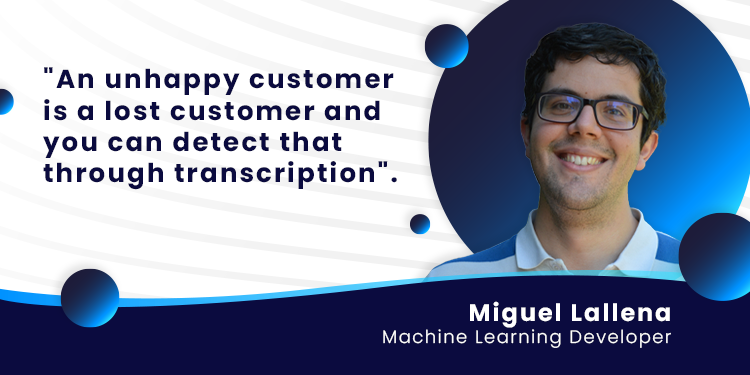
But what is a call transcription software, how does it work and what are its peculiarities? We are delighted to have our Machine Learning Developer, Miguel Lallena, tell us all about call transcription.
1. First of all, what is a call transcription software?
A call transcription software is a service that manages to transform what a person is saying in an audio to a text directly. To perform this service, the call transcription software will have a series of modules and models that will take the audio, extract its wave function, identify the sounds it produces and transform them into characters. These characters will then be combined into words and, using a set of internal metrics, it will determine which are the most likely words based on how they are usually combined.
2. What problems do you think it solves?
One of the most important solutions provided by the call transcription software is cost reduction. A company that wants to keep track of what its customers and employees are saying through calls would have to manage a large number of audios by hand, which would require several hours of work for each hour of audio. An automatic transcription software, on the other hand, avoids that problem since it only needs a fraction of that time to achieve the result. In addition, they are also capable of processing multiple audios at the same time, which translates into obtaining results at a lower cost and time.
Another solution provided by the call transcription software is text analysis. If this analysis were done manually, besides requiring a long time and effort, it would be susceptible to subjective factors of the person’s own judgment or human error. Automated transcription software avoids this problem because a client only needs to enter a set of rules for the transcriptionist to extract all the information about the analysis in a systematic and fast way.
3. Is voice identification the same as voice recognition?
Voice identification and voice recognition are different things.
On the one hand, we have voice identification, which is a biometric application that allows us to know which person is speaking by measuring voice parameters and comparing them with a database. On the other hand, we have voice recognition, which is the ability of software to identify what is being spoken. Speech recognition software can identify words and phrases in an audio file and convert them into a machine-readable format. Both technologies can be combined in the same product, but they are different.
To clarify, the two technologies differ in two main ways: depending on what you are looking for or depending on how you are going to train it. In terms of what you are looking for, voice identification looks for patterns inherent to a person such as tone or timbre of voice, while voice recognition looks for words or phrases that are independent of who is speaking. In terms of how it will be trained, when you are looking for voice identification you need software that is able to extract the pitch and timbre information and associate it with a person; meanwhile, when you want to perform voice recognition, you need a software that searches the phonemes that are pronounced and associates them with words and phrases.
4. What is the WER rate and why is it important for call transcription software? What is the optimal WER rate percentage?
WER is an acronym that means Word Error Rate. This value is obtained by making a transcription of an audio and comparing it with the correct text. In other words, the WER rate is the ratio of words that are wrong. When we talk about wrong words, we can refer to words that have been added to the transcription, words that are missing but should be there, or words that are not spelled correctly. Combining these factors with the total number of words in the correct text will give us the WER rate.
Of course, the optimal WER rate for a call transcription software would be 0 because it would be a sign that you are going to have a perfect transcription. But it is a value that cannot be consistently achieved due to the peculiarities of automatic transcription software. The job is to try to reduce it more and more with training, testing, or audio cleaning. Around 20-30% is acceptable and where most of the automatic transcription software are right now, but you must keep training it as I say, always keeping in mind that the more you train them, the more difficult it is to reduce the WER rate.
5. What other metrics or parameters are important to consider in call transcription?
An important parameter to consider is the speed of transcription. A manual transcription can give us a perfect text, but it would take hours or even days to get that result. An automatic transcription software, on the other hand, is capable of transcribing in a fraction of the time it would take manually, even less than the actual length of the audio. We usually talk about the “5x” factor, which means that for every hour of work of the automatic transcription software, 5 hours of audio will be transcribed. Moreover, if we add to this the fact that several instances or transcriptions can be launched in parallel, this speed is multiplied.
Another parameter to consider is confidence. Confidence is the degree to which the call transcription software is certain that the transcription is correct. A higher degree of confidence indicates that the call transcription software has performed correctly and therefore the transcribed text is more likely to be correct.
Finally, another parameter to consider is audio quality. The ratio of signal to noise is an important element because an audio with a lot of background noise will be more difficult to be transcribed correctly. In fact, it is important to use this noise to train the transcription engine in such a way that being able to distinguish the noise from the phonemes in the audio will help to improve the other parameters we are talking about.
6. What elements of a call are important for a call transcription software to detect?
One of the first elements to take into account is the identification of the language spoken in the calls because this is clearly the starting point for the transcription model that will be used to transcribe. If we have an audio in English, we cannot apply a Spanish transcription model to it and vice versa, even if we are dealing with similar languages such as Romance languages.
Another element to emphasize is the distinction between speakers in an audio. In the case of stereo audio, this distinction is easy because we will have the agent and the client each on a different channel. But the problem arises in two situations: several interlocutors in mono audio or typical audio of an Internet call, VoIP, where there is a host on one channel and several guests on another. In these situations, the process called diarization is performed, in which the audio is automatically studied and the voice corresponding to each speaker is distinguished.
Related to diarization, we find overlapping. Overlapping is the phenomenon that occurs when 2 or more people speak at the same time. In a company dedicated, for example, to telephone sales, overlapping will be an important factor to detect since it will provide information about the treatment given by the agent or possible customer dissatisfaction.
Waiting periods are another element to detect. These waiting periods can occur either because of the initial tone of voice, the waiting music, or because there is a silence within the conversation and can affect the company-customer relationship. It should always be bear in mind that a customer who is kept waiting for a long time is a dissatisfied customer, so it is essential for companies to detect these waiting periods and determine their duration.
Finally, another element to detect is the speed of speech. This can reveal a lot about an agent’s or a customer’s enthusiasm about a particular topic. In addition to being able to be studied at a specific moment in the call, the entire call can be measured, revealing information about the variation in an agent’s energy during the whole call.
7. Many companies have special needs because of the sector where they operate, can the transcription service be customized? What kind of customizations can be made?
Yes, it is possible to customize the transcription service, although it will require an effort on the part of the client, it is possible to do it. To do this, several elements can be used. Firstly, there are language models that are useful especially for companies working internationally or in multilingual countries such as, for instance, Belgium. In these circumstances, it will be possible to choose to have several language models and the company will be the one to request that each audio be transcribed through a model. You can even include dialects of the language.
On the other hand, in each language, there will be the possibility of using a generic model or more specialized models depending on the sector where the company operates. For example, a model for a bank will mention mortgage, APR, or pension plan, while a model for the health sector will include words such as gastroenteritis, coronary, or stroke.
But if you want to go even further, there are customizations that allow you to add names of competitors or your own products to these dictionaries. The company can provide a list of words together with the pronunciation of each one of them so that they can be included in the dictionary that feeds the model.
8. Is it difficult to implement a transcription model?
It depends on the technology you use, but initially, rather than difficult, I would say that it is a lengthy process. First, you need many conversations, like hundreds or thousands, that will contain several hundreds of hours of audio that are stored in a specific format. Secondly, you also need to have the transcription of all those audios into text, which requires a lot of work. Then you have to prepare the data, store the transcriptions, and all the other necessary elements together with the audios.
To continue, we have to create a dictionary of words, and, in addition, we need a model that associates a set of words with probabilities. It works in the same way as the text predictor of cell phones: each word will have a probability associated with the next word. On the other hand, each word must be associated with its pronunciation in writing through, for example, the IPA alphabet, that is, phonetic alphabets in which each sound is associated with a symbol.
Finally, once you have all of this, you will need an acoustic model that will associate the phonemes to the sounds and will be trained using neural networks, which requires more time because it performs a large amount of data processing, comparing them with the correct results and adjusting internally. As I say, it is a long process and it is also subject in all cases to the problem that, if there is a failure in the computer, you have to practically start again from the beginning.
9. Are there any new developments in the world of call transcription?
Currently, the main effort regarding automatic transcription software is focused on improving accuracy, reducing the WER rate and transcription speed. But recently, new ideas and complementary elements to this transcription are emerging and adding value, such as for example, keyword search. This will help companies to keep track of how their agents interact with customers and if they follow the scripts they should. On the other hand, they will be able to acquire the text of the transcripts and analyze it automatically to detect the feelings of the customers, to know if they are satisfied. An unhappy customer is a lost customer, and this can be detected through the transcript.
Finally, you can also analyze the syntax of the text as it can give you ideas of how the agent or the customer is expressing themselves and provide useful data. For example, an agent who speaks in the first person is an agent who is likely to be difficult to deal with.
10. And finally, what would you say to a company that is hesitating to use a call transcription software?
I would tell them that a call transcription software, properly used, will help them to increase the value of all the interactions they have with their customers. Every conversation you have will be a new source of data and information for the company, which will then have the ability to satisfy existing customers, attract new ones, and expand its sights to new horizons.
If you still want to learn more about call transcription software, click here.
Teleworking was already something that was beginning to be normalized in certain sectors such as IT, however, it was not until the confinement by the COVID-19 crisis, that the adoption of teleworking was accelerated, either to connect teams to each other, provide consulting services to customers or even provide support.
Such was the urgency of the need to connect work teams that the increase in the use of UCaaS, of which MS Teams, Webex, Zoom or Google Meets are part, was 41%. In fact, according to Microsoft, the number of active users on Microsoft Teams went from 32 million in 2020 pre-pandemic to 145 million in 2021, an increase of 453%, making Teams the fastest growing product of the technology giant.
These platforms have brought about a change in behavior and ways of working, and have brought numerous benefits, such as immediate installation, scalability, affordability and ease of use. In this way, an additional platform has been added to all the existing means of communication in the business environment, such as telephone, email or even fax in many sectors.
The challenge of Compliance
It is undeniably true that the adoption of UCaaS has been a relief for companies, however, companies face the challenge of ensuring compliance with data protection regulations as demanding as MiFID II or the GDPR for each and every one of the platforms through which they communicate with their customers or process their data.
MiFID II: Is the EU directive that regulates the recording of calls in securities trading. The legislation requires comprehensive recording and safeguarding of calls regardless of the channel, whether telephone, video call, chat or email.
RGPD: This is the European Regulation that regulates the encryption (anonymity) of information, data custody in secure environments, traceability and absolute control of access to data, the right to be forgotten and the right to portability.
CCPA: The Consumer Privacy Act regulates how companies around the world can handle the personal information of California residents; they have the right to know what information is collected about them, to know if and to whom their personal information is sold or disclosed to third parties, to access their personal information, or to request deletion of their personal information.
Therefore, having tools or programs that make companies comply with these regulations becomes an essential aspect for business continuity. Currently on the market there are numerous high-tech omnichannel communications recording software, which retention, custody and retrieval conditions solve the challenge of compliance in highly regulated and monitored industries, such as the financial sector.
Recordia Connector for Microsoft Teams
Microsoft Teams calls must be recorded and custodied as a matter of policy when using this platform as a means of contacting customers, obtaining their data and consents and providing them with services, so it is essential for companies to have recording software capable of automating the recording of these calls so as not to miss a single detail.
One such software is Recordia, which has developed the Connector for Microsoft Teams, addressing the enterprise onmicanality and solving the problem of compliance. The Recordia Connector is easily integrated into the platform. Active and ready to record 24/7, the Connector silently joins calls without interfering with call quality, announcing the recording to both parties and complying with legal requirements.
Capture calls made in MS Teams
With Recordia for Microsoft Teams, you can record both calls and video calls 1 to 1 or more participants, whether incoming or outgoing, both between Microsoft Teams users, as well as the calls of these users with external numbers. In addition, shared desktops are also captured so that no detail is lost.
Centralize all your recordings in a single application
With Recordia you can record all kinds of interactions, such as landline calls, mobile calls, SMS, emails, fax and now also Microsoft Teams calls and video calls. In this way, all the recording and storage is centralized in a single platform in a secure way, facilitating its later audit and retrieval, increasing security and efficiency in the task of recording and custody of interactions.
Increase the productivity of your agents
Provide quality training based on real Microsft Teams calls to your agents and sales reps to offer your customers an excellent experience or replicate the best sales and deals. In addition, monitor and ensure compliance with your quality standards and best practices among your employees, as well as provide top-notch customer service.
Track customer meetings comprehensively
The list of call participants and their data are recorded in Recordia, allowing you to keep a detailed follow-up of the contacts you have had with your customers or potential customers, as well as to monitor their development and maturity.
Comply with international regulations
Recordia helps you meet the technical privacy requirements of the regulations; Teams calls remain secure and encrypted in Recordia. Back-up or recover recordings at any time, successfully pass audits, prove the authenticity of the recordings and limit access to them, adjust the period and location of the servers in which custody is performed.
If you want to learn more about you can benefit from Recordia, click here.
It is often said that good businesses are those that always prioritize their customers and listen to them, but the real question is, do they really understand them?
Thanks to the advent of Artificial Intelligence, some professionals, such as digital marketers, see the need to incorporate call analytics into their strategies to better understand the customer and improve the entire customer journey in the sales process, as call analytics is a source of spontaneous, honest and uninfluenced feedback, as a survey might be.
But for marketers to understand the feelings, emotions or intentions of customers is often considered difficult, but the solution is within everyone’s reach: Sentiment Analysis. By incorporating new Artificial Intelligence technologies, such as Sentiment Analysis, marketers will be able to bring a differential value to the company’s marketing strategies.
Call recording has experienced a boom in recent years and this, together with call analysis through Speech Analytics, brings great benefits to companies and, specifically, to marketing teams as it helps to understand what customers are talking about and their needs. In fact, according to a Forrester study,“customers who call tend to buy more, make purchases faster and stay customers longer than customers on other channels. Customers who initiate a phone call during the customer journey convert an average of 30% faster and spend an average of 28% more.”
Given this data, it is normal and, in fact, necessary for companies to use call recording and Speech Analytics to bring differential value to their business, improving marketing and sales strategies and thus managing to adapt to customer needs.
But it is possible to go further. Thanks to new technologies based on Artificial Intelligence and natural language processing, marketing teams will be able to know the real sentiment of their customers, their positioning before a campaign, explore the mentality of the members of an audience and study the perception or image of the company from the user’s point of view. This makes Sentiment Analysis a great tool for in-depth product analysis, market research, reputation management or customer service, among others.
What is Sentiment Analysis?
Sentiment Analysis is one of the fields of natural language processing, dedicated to the exploration of subjective opinions or feelings collected from various sources on a particular topic.
The goal of Sentiment Analysis is to capture more information about customers, recognizing their emotions and helping companies to evaluate the mood of their brand and their sales or customer service team.
Create sentiment-based campaigns
Once we know what Sentiment Analysis is, it should be noted that call analytics with Speech Analytics provides a very good analysis of the performance of marketing campaigns but lacks the contextual elements that refer to what the customer’s experience with your brand or campaign was. Call analytics, combining Speech Analytics and Sentiment Analysis, are an example of how marketing can benefit from all the measurable information extracted from calls and use it to determine messaging, identify strengths and weaknesses, evaluate campaign effectiveness and measure customer sentiment.
Customer sentiment must be considered when developing marketing strategies, segmenting email campaigns, designing landing pages and automating marketing processes. Thanks to Sentiment Analysis, emailing, for example, can be explicitly written to meet the needs of the individual based on their sentiment score. Another example for which it can be used is to reduce customer churn. If a salesperson indicates that a customer has a negative experience, this knowledge of feeling can be used as a trigger to initiate a recovery campaign, before the customer disengages with the company definitively.
Using Sentiment Analysis, you can find out whether your marketing activities generated positive or negative reactions and subsequently verify your customers’ feedback. This helps you to rethink marketing strategies and, if necessary, better customize messages in the future to suit customers’ tastes and needs. Detecting negative, positive or neutral feelings about your marketing campaigns will help you to measure their success.
In summary, the benefits of Sentiment Analysis in marketing are numerous and technologies that use Speech Analytics together with Sentiment Analysis, such as Recordia, can bring great value to your company.
If you want to know more about our Speech Analytics and Sentiment Analysis solution, Recordia, click here.
Surely, or almost certainly, you have seen the acronym PCI DSS at some point, and perhaps you are not entirely clear on what it means, well, PCI DSS is the acronym for Payment Card Industry Data Security Standard.
PCI DSS is a set of security standards that helps companies prevent fraud and theft of credit card data, which involves both the cardholder’s personal data and authentication data.
PCI DSS arose in 2004 from the union of the largest credit and debit card companies in the world, AMEX, VISA, MasterCard, Discover and JCB, decided to create a single standard common to all of them, since, previously, each of these companies had their own security standards (which resembled each other), which could cause some confusion.
It is important to highlight two aspects:
PCI DSS is a standard, not a law. It is enforced by contracts between merchants, acquiring banks and payment brands, not imposed by country governments.
Another important point is to keep in mind that breaking PCI DSS means a General Data Protection Regulation (GDPR) breach. This is because credit and debit card information are cardholder data that is classified by the Regulation as personal data under its protection. It is worth remembering that the most severe breaches of GDPR compliance are punishable by up to 20 million euros or 4% of the company’s annual turnover (whichever is higher between the two options).
What does PCI DSS say?
The PCI DSS standard is made up of twelve requirements to be fulfilled classified into 6 fundamental aspects.
Build and maintain a secure network.
Install and maintain a firewall configuration to protect data.
Do not use vendor-supplied passwords or defaults.
Protect cardholder data.
Safeguard cardholders’ personal information.
Encrypt the transmission of cardholder data and confidential information over open public networks.
Establish a vulnerability management program.
Update and activate anti-virus software on a regular basis.
Develop and maintain secure systems and applications. Develop and maintain secure systems and applications.
Create strong access control measures.
Limit access to information to only those companies that need it.
Assign a unique ID to each person with access to the system.
Restrict physical access to data to card owners only.
Regularly monitor and test networks and access.
Track and monitor access to network resources and cardholder data.
Perform regular testing of security systems and processes.
Maintain an up-to-date cross-cutting information security policy.
Create a policy that covers and keeps up to date the aspects related to information security.
Who does PCI DSS apply to?
At this point, you may be wondering what kind of companies PCI DSS applies to or what requirements they must meet. Well, this standard must be complied with by banks, merchants, and issuers or any other entities that process, store, or transmit credit or debit card data.
The PCI SSC (PCI Security Standards Council) created a four-tier system to classify businesses by size and risk to determine the requirements that apply to individual businesses. These merchant risk levels are based on the total number of payment card transactions a business conducts annually.
The PCI-DSS Standard is composed of four levels of compliance, which are based on the annual number of transactions of a merchant, depending on the level in which the entity is located, they will have to comply with more demanding requirements, for example, in level 1, an annual compliance report must be submitted, which is called ROC or Report of Compliance, while for the other levels this is replaced with a self-assessment questionnaire called SAQ or Self-Assessment Questionnaire. Quarterly network scanning by an Approved Scanning Vendor (ASV) and possession of the Attestation of Compliance (AOC) that declares an organization’s PCI DSS compliance status is common to all four levels with some exceptions. The levels are as follows:
PCI-DSS Level 1 is for businesses that handle more than 6 million Visa or MasterCard transactions each year, or 2.5 million at American Express.
PCI-DSS Level 2 is for businesses that process between 1 million and 6 million transactions annually.
PCI-DSS Level 3 is for businesses that process between 20,000 and 1 million Visa or MasterCard transactions each year.
PCI-DSS Level 4 is for businesses that process fewer than 20,000 Visa or MasterCard online transactions annually.
Call Recording and PCI DSS Compliance
Online commerce is currently booming, and many companies are spending more effort on online deployment than on physical deployment. This means that companies must install an adequate payment infrastructure, and part of this is what we call payment gateways, which are programs that connect a bank account with the corresponding payment processor where the customer manually enters their data.
However, the real challenge is in MOTO (mail order/ telephone order) payments. The fact that calls in call centers are recorded is considered commonplace, e.g., for quality reasons. However, the main reason why these calls are recorded in compliance since these calls often involve the transmission of data that is protected by regulations such as GDPR.
Returning to the subject of MOTO payments; in Call Centers, especially in those dedicated to sales, on many occasions sales are closed with customers who must authorize payment through their credit or debit card data, data that cannot be recorded under any circumstances. For this reason, there are several alternatives such as the use of software that stops recording at that moment and resumes recording once it is finished. But these are not entirely effective.
What is really effective and secure is to opt for a conversational intelligence solution that anonymizes sensitive credit card data. Artificial intelligence anonymization techniques, such as the one used by Recordia, automatically detect and remove PCI data from call recordings using a high-precision speech recognition engine and machine learning algorithms. The credit card data is automatically erased from the recording and replaced with white noise, returning the clean recording and transcript with the data removed to users.
Want to learn more about Recordia Speech Analytics and its PCI Anonymization solution? You can find more information here.
The use of call recording in Call Centers has become generalized a few years ago in order to monitor randomly the calls to evaluate the quality of the service provided to customers. But this call monitoring required a great effort, both financially and personally, on the part of the Call Center supervisors. Today, thanks to the development of Artificial Intelligence technologies such as Speech Analytics, Call Centers can monitor incoming calls automatically and much more efficiently, achieving greater potential and optimization of operations.
But, although Speech Analytics is one of the major trends in the Call Center industry for quality control, today this intelligent speech analysis tool is not only applied for this reason, but also influences other business areas and functionalities, such as customer experience, training of employees or the adaptation of sales tactics or marketing plans, among others. In addition, tools for analysis based on Artificial Intelligence have been evolving, with the emergence of others such as Sentiment Analysis or Biometric Identification which, used individually or together, bring many more benefits to Call Centers.
But what is Speech Analyticsfor the Call Center and what benefits does Artificial Intelligence bring?
What is Speech Analytics for Call Centers?
Speech Analytics is a tool, powered by Artificial Intelligence, that automates the process of listening and analyzing conversations with Call Center customers. Speech Analytics extracts, analyzes, and processes information from customer interactions that, without this technology, would be impossible to perform manually.
Once the information from customer interactions has been extracted, Speech Analytics allows Call Center supervisors to make decisions based on real data and knowledge, improve agent and process performance, innovate in products or services, understand what is happening at any given moment with customers or make predictions of how potential problems may affect the company, among other things.
What are the benefits of Speech Analytics for Call Centers?
Agent training
With all the information extracted from Speech Analytics, supervisors can train their agents and identify best practices and sales techniques. In addition, these calls can serve as examples for agents, newly hired or not, helping them to develop scripts to be more successful in their future calls.
Sales and marketing campaign management
Thanks to Speech Analytics you can automatically detect which sales techniques are successful and which are unsuccessful and why, as well as identify keywords and themes to improve and optimize the entire sales process and sales pitch. In addition, with all this key information Call Centers will be able to adapt their marketing campaigns to the demands and needs of customers to achieve greater sales and results.
Quality Control
With Speech Analytics, Call Center supervisors will be able to establish specific keywords that will help them to identify risks, inefficiencies and obtain information with the objective of reducing costs and making processes more fluid and efficient. Speech Analytics helps you to automate the process of early detection of bad work practices, allowing you to quickly reverse them and control the quality of processes and customer service.
In the same way that the information extracted from Speech Analytics helps Call Centers to identify the best sales pitches, it will also help them to listen to customers, detect the most recurring concerns and potential problems with products or services and introduce innovations to enrich and improve them.
Customer experience
One of the most common reasons for Call Centers to implement Speech Analytics is to improve the customer experience. This technology analyzes audio data to help them to understand customer needs and expectations, identify certain behavioral patterns and predict trends that can improve service quality.
Speech Analytics for Call Centers and other AI technologies that benefit them
Some more advanced Speech Analytics software, such as Recordia, not only allows to analyze the text but also the customers’ feelings (Sentiment Analysis). After defining and tagging calls with the associated sentiments using keywords or phrases, Sentiment Analysis can analyze, through Artificial Intelligence and Machine Learning, the user’s behavior during calls, defining the emotions of the people who are speaking.
The use of Speech and Sentiment Analytics combined with other new technologies based on Artificial Intelligence, such as Voice Biometric Identification, facilitates the work of Call Centers, making them more efficient and effective. In the case of Voice Biometric Identification, it is useful for sectors, such as finance or healthcare, where identification processes are lengthy and worsen the customer experience by asking numerous security questions because they deal with sensitive data. With Voice Biometric Identification, Call Centers of these highly regulated industries can securely and efficiently identify users, ensuring regulatory compliance and preventing fraud, especially the most common type of fraud known as identity theft.
If you want to learn more about our Speech Analytics solution and how it benefits Call Centers, click here.
Cyber-attacks and fraud are the daily life of many companies and customer data can be left unprotected and within the reach of anyone, which is a severe danger especially for sectors such as banking due to the sensitivity of the data they handle. We also find ourselves in a new context, accelerated by the COVID-19 pandemic, in which online banking and telephone customer service are the order of the day.
Faced with this new reality, the customer service agents of financial institutions are receiving more and more calls for their usual transactions instead of choosing the face-to-face method. However, these calls involve the management of sensitive customer data each time they are made by this means, and it is mandatory to ensure this personal data is handled in an ethical and responsible manner and to minimize the chances of committing fraud in the identification of the customer.
For this reason, Voice Biometric Identification technologies, such as Recordia, have emerged to help solve this widespread problem in the banking sector.
Let’s get to the point, what is Voice Biometric Identification and how does it help this sector?
What is Voice Biometric Identification?
Biometric Identification is, quite simply, the process of verifying a person’s identity by using their unique characteristics, and then allowing them to securely access a service, application or device.
To understand it better, biometrics is the general name used to refer to any biological or physical characteristic susceptible to be measured so that they can be used to identify people, such as facial pattern, fingerprint, voiceprint or iris pattern, among others. In this way, Biometric Identification verifies the identity of individuals according to the chosen biometric characteristic. In the case of voice biometric identification, you will be able to accurately identify your customers in a matter of seconds by recognizing the specific voiceprint of each of them.
How does Voice Biometric Identification help the banking sector?
Compliance with international regulations
International data protection regulations, and specifically the GDPR, state that individuals must voluntarily give specific, informed, and unambiguous consent to companies to process their data. This means that financial institutions must have and retain this consent in order to comply with regulatory standards.
Thanks to more advanced voice biometric identification technologies, such as Recordia, once the customer is identified, agents during the call will also be able to see on screen the status of the consent of each customer for those regulations which it is necessary to obtain it. This ensures full compliance with data protection regulations that apply to financial institutions such as GDPR, MiFID II, PCI DSS or the DODD-FRANK ACT, among others.
Maintaining process security and preventing fraud
Today, accelerated by the pandemic produced by COVID-19, the use of digital banking and the services associated with our finances is becoming more and more generalized. Although the banking sector has benefited from this fact by lowering costs and facilitating management processes, it is suffering significant losses due to fraud related to them. The most common case is identity theft, making it necessary to develop and implement more demanding and complex solutions that detect attacks and ensure the integrity of user data, without interfering with the user experience.
In this way, Biometric Identification technology helps to enhance the security of banking procedures in order to protect customers. More advanced voice biometric identification technologies, such as Recordia Biometric Identification, not only work at the beginning of the call, but also throughout the call, ensuring that the voice matches the correct person every second. In the event of a mismatch, agents will automatically see a non-match warning on their screen, allowing them to quickly detect and report fraud even if security questions are answered correctly.
If you want to learn more about our Biometric Identification solution and how it helps with regulatory compliance and fraud prevention, click here.
Quality customer service and a seamless user experience result in satisfied customers and increased sales volume. The fact that Call Center agents can use text transcription of their calls will help them not only to understand the quality of the service they provide, but also the needs of their customers in order to adapt their sales pitch or sales tactics to these needs.
That is why, nowadays, in order for a Call Center to achieve an effective customer service experience and quality care, call recordings and transcriptions are an important and even essential part of the process. Thus, technological solutions based on Artificial Intelligence, such as Recordia Transcription together with its Speech Analytics and Sentiment Analysis tools, allow to take the customer service experience to the next level, training employees for a better achievement of objectives and quality standards.
Call transcription is the process of converting conversations that take place over the phone call into written words (also known as Speech to Text Transcription) and provides sales reps with reviewable records of all conversation agents have with customers.
Transcription software works by listening to audio and delivering an editable transcript to a given device through speech recognition. Speech-to-text conversion relies on a complex machine learning model to be performed in several steps.
Some Transcription solutions, such as Recordia Transcription, work with great precision and understand interruptions or overlapping voices, distinguishing them and delivering the complete conversation in text differentiating all the interlocutors. This allows to later analyze the calls individually or globally through Speech and Sentiment Analytics, or to use them as evidence.
How do employees improve with call transcription?
Workforce development for agents currently employed
Call transcription will provide valuable information and data on the techniques and scripts that work best with customers and the agents who have made the most sales. Training agents individually and empowering them with real scripts and quality content extracted from call transcription will result in more efficient handling of customer demands and queries, adapting to the real needs of the customers.
On the other hand, knowing through call transcription the problems that arise with customers or the sales tactics that work best and training them properly will achieve more security in the staff and reduce staff turnover by solving possible situations of stress or tension in workers.
New employee training in on-boarding processes
By knowing the sales tactics that work best and extracting real scripts from the conversations managed with the Transcriptor, you will make the on-boarding process of new employees faster and smoother, showing them real calls in order to train them and provide them with tools to overcome all possible situations.
Training new recruits with real scripts will allow them to perform better in their new job and to follow the quality and service standards set by the company. In addition, these trainings will help the Call Center to create a better prepared and higher quality sales team.
Identifying bad practices
Thanks to the information extracted from call transcriptions, companies can identify the best agents, learn from them and create training material for the rest of the team based on successful results. This will help to ensure compliance with the quality standards of the processes and work methods imposed by the company’s philosophy.
In addition, call transcription and the further use of technologies such as Speech Analytics will help you to automate the process of early detection of bad work practices, allowing you to quickly reverse them and train the agents who are carrying them out.
Silence analysis
Silences during a call with a Call Center agent are considered normal and unavoidable, as the agent takes time to check the caller’s data. However, prolonged silences of 20% to 30% may hide problems that can cause additional costs and need to be addressed. The reasons for these silences can range from not finding the answer to the customer’s questions to not being sufficiently trained.
Transcription software, such as Recordia Transcription, helps to identify, measure and analyze silence in order to understand how the workflow is working and how agents are handling calls with the goal of reducing average call time and increasing Call Center efficiency and customer satisfaction.
If you want to learn more about how call transcription helps your employee to development, click here.
Call Centers have become a strategic element of the company, regardless of the sector, and deal with a variety of issues, from contracting or information about products and services, to after-sales service issues, such as questions about how a product or service is installed or works, or complaints or concerns about them. These issues are usually dealt with in emails, calls, chats or other means, and having knowledge of them in both valuable and essential for companies to ensure, improve and maintain a sublime customer experience.
However, Call Centers handle large volumes of calls, emails and other interactions, and in the case of large companies, thousands of calls per day, so the analysis of these calls can be really complicated for companies. However, there is high-tech software capable of storing all these interactions and analyzing them.
Thanks to these advanced technologies, such as Sentiment Analysis, Call Centers can find new ways to improve the customer experience, gaining more information about customers and their needs, complaints, queries, satisfaction or dissatisfaction by analyzing the large volume of calls they receive easily and efficiently. Sentiment Analysis, when used correctly, allows companies to discover what works and what makes their customers leave, helping them to make data-driven decisions, gain a competitive advantage and make the customer experience the best it can be.
Transcription and Speech Analytics performed on company calls have evolved towards other technologies and Artificial Intelligence tools that go beyond keywords recognition. This is how Sentiment Analysis arises with the objective of capturing more information about customers, recognizing their emotions and helping companies to evaluate the mood of their brand and their sales or customer service team.
Sentiment Analysis is one of the fields of natural language processing, dedicated to the exploration of subjective opinions or feelings collected from various sources on a particular topic.
Sentiment Analysis is an opportunity to explore the mindset of the members of an audience and to study the perception or image of the company from the user’s point of view. This makes Sentiment Analysis a great tool for in-depth product analysis, market research, reputation management or customer service, among others.
Benefits of Sentiment Analysis for CX
Knowing the source of customer dissatisfaction and training Call Center agents
Sometimes, when a customer contacts the Call Center, the reason for the dissatisfaction may not be understood, either because the explanation may be vague or because the agent does not comprehend the reasons for the dissatisfaction. Sentiment Analysis is designed to eliminate these confusions so that agents know exactly why a customer is dissatisfied by identifying language that conveys displeasure, raised tones or the overall negative sentiment of the intervention.
In addition, Sentiment Analysis is not only beneficial for detecting customer dissatisfaction but also for training agents. This data collected on the source of dissatisfaction allows employees to be trained with scripts based on real situations and issues, enabling them to deal effectively with customer requests, queries or complaints, thus improving the customer experience.
Improving inefficient products and processes
We live in a world with quick and easy access to products and services, which means that callers to a contact center expect quick resolutions that lead to a better customer experience. Leaving someone on hold longer than necessary could result in an unhappy customer. Sentiment Analysis, together with Speech Analytics, is designed to examine pauses and long periods of silence and to determine what is going wrong and which processes are causing customer dissatisfaction in order to improve them and achieve greater efficiency and customer experience.
In addition, it is interesting to know what customers think about the products and services offered by the company. Adapting products and services to the real needs of the customers expressed in the calls will mean a better customer experience, improving the levels of satisfaction with the company and its service.
Boosting customer loyalty and reducing churn rates
When customers feel they are not well served, they are likely to look to competitors for an answer. The data collected by Sentiment Analysis and Speech Analytics can be used to better serve customers’ needs, improve the customer experience and thus make them trust your company, which increases loyalty and reduces churn. In addition, satisfied customers are more likely to tell others about your company, which can lead to new customers.
If you want to learn more about the benefits of Sentiment Analysis, click here.
Market research allows to know the opinions, preferences, motivations, obstacles, and even suggestions for product improvement, of customers and to obtain essential conclusions and insights to make the most appropriate strategic and operational decisions.
But this market research is, at first, costly and this, added to the new forms of communication, such as the increased use of mobile telephony or social networks, has generated a greater amount of valuable information that may be exploited in a limited way and may be insufficient.
Given this reality, analyzing the interactions that take place with customers is the best way to enhance and complement the results of market research and to learn and acquire valuable information, beyond surveys, about behavior and consumption patterns, as well as suggestions for improvements regarding the products or services offered by the company. But manually reviewing and analyzing all interaction recordings is not realistic and not an efficient method because it would consume a lot of time and resources. That is why Artificial Intelligence-based technologies, such as Recordia Speech Analytics, emerge, which can transcribe and analyze 100% of calls and other interactions (such as SMS, emails or meetings in MS Teams) generating valuable information in order to reveal trends, concerns and opportunities.
In this post we show you how Speech Analytics helps you to optimize your company’s products and services. But first, let’s define what Speech Analytics is.
Speech Analytics, what is it?
Speech Analytics captures, classifies and groups 100% of the conversations at the enterprise level 24 hours a day. After indexing millions of conversations, Speech Analytics technology uncovers hidden information beyond surveys and reviews, allowing you to understand what is happening in your business based on the keywords and aspects of your business operations that you are looking to uncover.
Everyday Speech Analytics is more advanced and allows you to perform more complex and real-time analysis, not only on calls (audios) but also on SMS, e-mails, faxes, video calls through MS Teams or 1-to-1 meetings between the company and its customers.
Benefits of Speech Analytics in product and service optimization
Monitor trial periods and new product launches
Many companies set test periods for their new product launches. With Speech Analytics, you can automatically analyze call recordings to identify and classify all calls related to the product trial period. You will then be able to detect what you like and what you don’t like in these test products, detect dissatisfaction or possible improvements and thus launch a definitive quality product that meets the real needs of customers.
Thanks to Speech Analytics, you will be able to measure which products are going to be successful in the market and generate a high level of customer satisfaction.
Obtain a competitive advantage and detect customer preferences
One of the best and most underused ways to benefit from Speech Analytics is to stay ahead of the competitors. Speech Analytics helps companies create targeted call searches that address the competition. Knowing which competitors are naming our customers or what they are talking about is interesting for the company to get useful information to meet industry standards.
Using Speech Analytics to track customer interest in other products or services offered by competitors is an opportunity for companies to learn about real customer preferences, what they demand and what they need, and to create products that match them. In addition, this information will help companies to understand the market environment and thus provide resources to the company that will enable it to face the competition better in the fight for consumer preferences, thus gaining a competitive advantage.
Match existing products to customer needs
Call recording can be very beneficial to the R&D department in terms of product development. By listening to what customers and potential customers are looking for in a product or service, it will help to improve and adapt products and services to their needs.
In short, through the active listening that Speech Analytics allows, companies obtain valuable data and information about the experience that customers have with their products or services, giving them the possibility to make improvements that will help them get the most out of their business, improving customer satisfaction and loyalty.
If you want to learn more about how Speech Analytics helps companies with product optimization, click here.
Speech Analytics is becoming one of the most demanded technologies in recent years by companies from different sectors. Most companies have implemented Call Recording software for quality control or to ensure regulatory compliance, but many companies realize that the data and information contained in these recordings can be used for other purposes, bringing great benefits to the different deparments of the company. In fact, in departments such as sales or marketing, Speech Analytics technology has been growing in recent years.
But what is Speech Analytics and how can it helps companies to increase sales? Let us explain you how.
Speech Analytics is a technological tool powered by Artificial Intelligence, that automates the process of listening and analyzing conversations with customers. Speech Analytics extracts, analyzes, and processes information from customer interactions that, without this technology, would be impossible to perform manually. With this information extracted from customer interactions, Speech Analytics allows making decisions based on data and knowledge, improving performance through statistics and metrics extracted from interactions, innovating the business, understanding what is happening at any given moment and predicting how it can affect the company to anticipate changes.
To understand the needs and desires of customers, it is best to listen to exactly what they are saying. It is impossible for companies to listen to thousands of calls they receive every day, which is why many turn to AI-based technologies such as Speech Analytics. Speech Analytics software captures, classifies, and aggregates 100% of all interactions at the enterprise level 24 hours a day. After indexing millions of conversations, they uncover hidden information beyond surveys and reviews, making it easier and simpler to understand customers by detecting customer needs or potential dissatisfaction.
Identification of sales opportunities and analysis of the current market and trends
An effective call analysis strategy with Speech Analytics allows companies to gain valuable insights into customer interactions, helping to gain a better perspective of the sales and marketing team. Speech Analytics allows you to extract call data related to products, services, pricing and service quality. By analyzing conversations with customers, companies are able to identify what matters to them, categorize key issues and discover which processes need improvement. This, in turn, will enable companies to solve problems before they escalate and reduce customer churn.
Speech Analytics can help a company understand what needs to be strengthened to maintain customer loyalty, from detecting which competitor’s products and services are capturing customers’ attention and improving marketing campaigns that are not working, to making improvements to the company’s own products or services.
Detection of unsuccessful calls and agent training
Speech Analytics can automatically detect which sales techniques are successful and which are unsucessful and why, as well as identify keywords and topics to improve and optimize the entire sales process and sales pitch.
With all the information extracted from Speech Analytics, sales reps can train their agents and identify best practices and techniques. In addition, these calls can serve as examples for agents, newly onboarded or not, helping them develop scripts to be more successful in their future calls. Having background, such as scripts and records of actual calls or meetings, as part of the training for newly hired sales agents will help them internalize best practices and how to approach each vertical more quickly and effectively.
Sentiment Analysis together with Speech Analytics
Some more advanced Speech Analytics software, such as Recordia, allows you to not only analyze text but also customer sentiment (Sentiment Analysis). After defining and tagging calls with associated sentiments using key words or phrases, you can analyze, through Artificial Intelligence and Machine Learning, the user’s behavior during calls, defining the sentiments of the people who are speaking,
Speech Analytics together with Sentiment Analysis technology gets to the bottom of customer dissatisfaction by revealing the pain points and underlying reasons why people are dissatisfied with your product or service. The result is that queries are resolved quickly, and small problems don’t escalate, helping to reduce churn rates and increasing the probability that customers will return to those products or services.
If you want to learn more about how Speech Analytics helps to increase sales, click here.
It is true that there are other reasons why Call Recording helps companies, such as quality or customer experience, however, we must not forget that one of the purposes that have had greater weight in recent years is the regulatory compliance.
<<< Learn more about how to use Call Recording for Compliance >>>
The way in which data is created, stored and shared changes everyday thanks to technological developments. This has led to the creation of extensive regulations, policies, standards and laws that companies are obliged to comply with in order to protect data privacy and be aware of potential compliance gap, so as not to incur a negligence or carelessness.
International data protection regulations:
Among all the international regulations created to protect customers’ personal data and privacy, we present you some of the most important ones affecting Call Recording are GDPR and CCPA for regulating data privacy and PCI DSS, MiFID II and DOD-FRANK ACT for regulating transparency in the financial sector.
Failure to comply with these regulations can result in companies facing criminal liability, costly lawsuits, fines and dilapidation of their reputation in the marketplace. Indeed, in the case of the MiFID II directive, non-compliance entails sanctions ranging from €600,000 to €5 million or 10% of total annual turnover. Or in the case of non-compliance of the GDPR the sanctions can rise to up to €20 million or 4% of the company’s annual turnover.
Thus, not only ensuring full compliance with regulations and ethical behavior, but also transmitting this transparency to their customers, becomes essential for all companies, especially for those in stricter sectors such as finance, and this is where call recording comes into play. In fact, companies have introduced the position of Chief Information Security Officer, known as CISO, who knows in detail the regulations to which the activity of his company is subject and whose mission, among other aspects, is to ensure compliance, as well as the creation and adoption of recovery plans to respond to unplanned incidents and minimize their effects and training plans with which to instruct work teams.
How do Call Recording help to comply with regulations?
Call Recording technology solutions such as Recordia allow you to make these call recordings in a safe and responsible way, complying with international data protection regulations. In the specific case of Recordia, it is designed and certified to meet the technical requirements of security and data privacy necessary to comply with all the international regulations described above. Recordia helps you to comply with international regulations through:
Capture and custody: record all interactions legally and adjusts the custody period and geographical location of the servers where your encrypted captures will be securely stored.
Centralize and manage recordings in a single program, all recordings and captures remain secure within Recordia.
Ensure authenticity and transparency, thanks to the HASH fingerprint it is proven that each interaction remains unaltered from end to end.
Control access, limiting access to data; configure access and permissions for Recordia users. Two-factor authentication (A2F) is required for access.
Retrieve and shares all interactions: the trace of your interactions can be retrieved at any time in case of audit or query, or if their modification or deletion is required by users.
If you want to learn more about Recordia Call Recording, you can get it here.
Go one step further with Artificial Intelligence
Although one of the most compelling reasons for using Call Recording is compliance, there are many other reasons to use it. Recording for quality reasons, to improve the customer experience or for employee training is becoming increasingly important in companies.
However, these recordings, far from remaining a static resource that only involves a storage cost, can be a very interesting source of information for companies, exploitation is legal. This is what has led to the creation of a technology that has been gaining momentum in recent years, Speech Analytics, which purpose is to extact information and trends from thousands or even millions of recordings thanks to Artificial Intelligence.
For this reason, companies that once created Call Recording software, have opted for a product development strategy, implementing Speech Analytics. Recordia is one of them, providing solutions based on Artificial Intelligence such as Speech Analytics, Sentiment Analysis, Biometric Voice Identification or Call Transcription, which allow you to classify and group 100% of your conversations, offering insights and key information for your business.
For more information on how Recordia helps companies comply with international data protection regulations, you can find it here.
A Reuters article (2021) reported that the U.S. Securities and Exchange Commission (SEC) opened an investigation into how Wall Street Banks documented and tracked digital communications among their employees.
Reuters exposes that, despite the U.S. SEC and the Financial Industry Regulatory Authority requiring broker-dealers to record all digital communications related to banking operations to prevent a limitation on potential investigations or ensure good practice, the adoption of teleworking that was forced by the pandemic of COVID-19 meant the proliferation of online communication and messaging platforms, and the use of emails, social networks or WhatsApp on personal devices to communicate issues related to working development, which poses a problem to carry out the documentation of these communications, as acknowledged by the U.S. SEC’s chief compliance officer, Gubit Grewal, according to Reuters.
Moreover, in the event of an investigation, it is unclear in the U.S. how far the requirements to review personal devices can go to obtain communications between employees without interfering with or violating their privacy.
Issues to address in employee-to-employee communications
Therefore, Wall Street banks and broker-dealers need to take action to ensure compliance with U.S. SEC and Financial Industry Regulatory Authority requirements and develop an action plan to address the current situation and take measures to address it:
Omnichannel communication.
The use of personal devices for business communications.
The use of mobile lines over fixed lines.
The lack of infrastructure for recording and documenting communications.
Ensuring ethical and transparent performance.
Software for recording and registering internal communications.
In the work of documenting and monitoring communications between employees and transparent performance of the activity, it is advisable to adopt recording software whose infrastructure and activity is developed in the cloud, since the security provided by cloud services is superior, due to the restrictions and access control.
The use of communications recording software, such as Recordia, which addresses the problem of the diversity of communication platforms and the challenges posed by the documentation of these communications for financial institutions, also it ensures total data encryption and offers the possibility of performing back-ups in case of investigation or requirement.
Recommended best practices
In addition to implementing recording software, not only is it necessary to provide secure communication platforms whose transmissions can be recorded, but also a change in corporate culture on the part of brokers and Wall Street banks, here are some of our recommendations:
Limit the use of personal devices, emails and personal social networks, in addition to instant communication platforms such as WhatsApp or Telegram.
Provision and promotion of internal digital communication platforms to employees that are instant and convenient and are adapted to both on-site and telecommuting that encourage their use.
Implementing a culture of awareness of the importance of transparent and ethical communication, as well as a full understanding of the cybersecurity and non-compliance implications.
How Recordia complies with U.S. SEC and Financial Industry Regulatory Authority regulations
Recordia is a service that allows companies to record and store omnichannel communications such as landline, mobile, email, fax, SMS, or legally and ethically important Microsoft Teams calls in a secure and scalable environment for a specified period.
In addition, in case employees need to use smartphones, Recordia has the RTS service, to train employees with cell phone lines, also called softphones, whose calls are also captured in Recordia. It should be noted that, for communications that are not interested in being recorded due to their nature or privacy, the Record on Demand (ROD) service can be enabled, which records on demand, that is, authorized personnel can stop the recording at a given time for legitimate reasons.
Recordia allows access to these records or to make a backup with the possibility of being provided later as evidence or for their elimination if requested, complying with international data protection regulations and guaranteeing an ethical and responsible use of them, thus responding to the problem exposed by Gubit Grewal and to the requirement of keeping a record of communications at work.
If you want to know more about Recordia and how it can help you comply with the U.S. SEC and the Financial Industry Regulatory Authority, click here.